

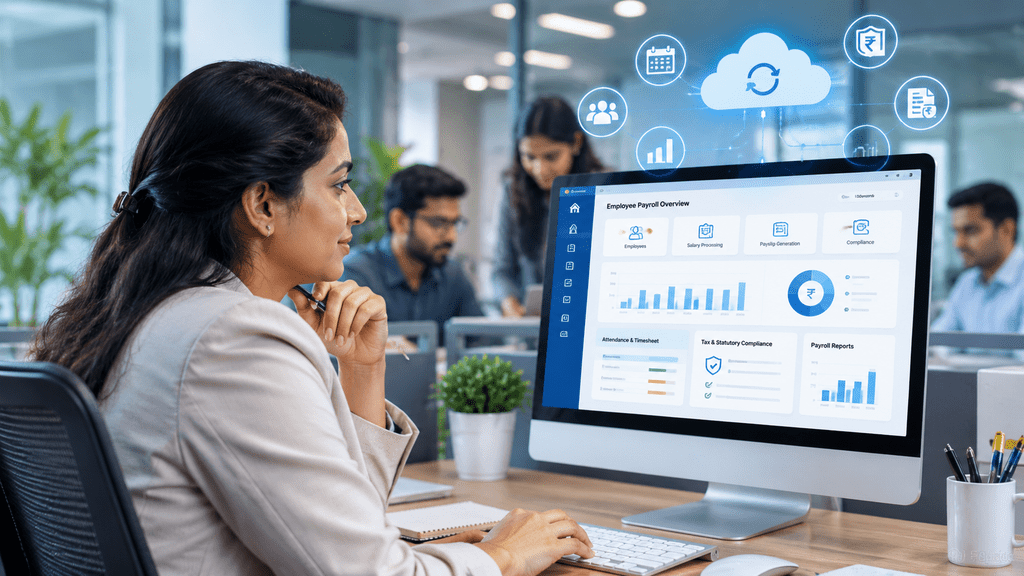
Managing employee salaries is one of the most important responsibilities of every business. Payroll involves much more than simply calculating monthly salaries. HR and finance teams need to manage attendance, working hours, leave adjustments, allowances, deductions, taxes, payslips, statutory contributions, and payroll records accurately.
As businesses grow, handling these processes through spreadsheets and manual calculations can become time-consuming and difficult to manage. This is where Cloud Based Payroll Software India can make a significant difference.
A cloud-based payroll system brings payroll processes together on a centralized online platform. It can automate salary calculations, generate digital payslips, support statutory compliance, and connect payroll with attendance and timesheet information.
For businesses looking to reduce repetitive administrative work while improving payroll accuracy and transparency, cloud payroll software provides a more structured approach to salary management.
What Is Cloud Based Payroll Software?
Cloud based payroll software is an online payroll management system that allows businesses to manage employee salary processing through a secure cloud platform.
Instead of maintaining multiple spreadsheets or files on individual computers, payroll-related information can be managed centrally. Authorized HR and finance users can access the system according to their permissions.
A modern cloud payroll system can support processes such as:
- Employee salary management
- Automated salary calculations
- Allowances and deductions
- Attendance and leave adjustments
- Timesheet integration
- Tax calculations
- Statutory contributions
- Digital payslip generation
- Payroll reports
- Payroll records and documentation
This makes payroll management more organized and reduces dependence on repetitive manual calculations.
Why Businesses in India Need Cloud Payroll Software
Payroll processing in India can involve different salary structures, deductions, employee benefits, attendance records, taxes, and statutory requirements.
When these activities are managed manually, HR teams may spend considerable time checking calculations and preparing salary records.
Common payroll challenges include:
- Manual salary calculations
- Errors in deductions
- Delayed payslip generation
- Maintaining multiple employee records
- Attendance and leave reconciliation
- Difficulty tracking payroll information
- Compliance-related administrative work
- Time-consuming payroll reporting
Cloud Based Payroll Software India helps address these challenges by bringing payroll activities into one automated system.
How Cloud Payroll Software Simplifies Payroll Management
A cloud payroll platform can automate several repetitive activities involved in every payroll cycle.
1. Automated Salary Calculation
Salary calculations can include basic salary, allowances, bonuses, deductions, reimbursements, and other pay components. With predefined payroll rules, the system can calculate salary components automatically, reducing the need for repeated manual calculations.
2. Automatic Payslip Generation
Preparing salary slips manually can take significant HR time, particularly when a company has many employees. Cloud payroll software can generate digital payslips automatically after payroll processing. Employees can receive their salary information digitally instead of depending on manually prepared documents.
3. Attendance and Timesheet Integration
Employee attendance, working hours, overtime, and leave can influence salary calculations. Integrating attendance and timesheet information with payroll helps ensure that salary calculations are based on relevant employee work records.
4. Tax and Statutory Compliance
Payroll teams need to consider applicable tax and statutory requirements while processing salaries. A payroll system can help apply relevant payroll rules and generate reports related to statutory contributions such as PF and ESI, along with other applicable requirements. Businesses should still review their payroll configuration and compliance requirements with qualified professionals.
5. Centralized Employee Payroll Data
Managing payroll information through different spreadsheets and files can create version-control problems. A centralized cloud system keeps employee payroll information organized in one place, making it easier for authorized users to access and manage records.
Key Features to Look for in Cloud Based Payroll Software India
Choosing payroll software should not be based only on salary calculation capabilities. Businesses should consider the complete payroll workflow.
Automated Payroll Processing
Simplify repetitive payroll calculations and reduce manual intervention
Employee Master Data
Manage profiles, salary structures, and payroll information centrally
Automatic Payslips
Generate digital salary slips instantly for all employees
Attendance Integration
Connect leave and timesheet data with payroll calculations
Tax & Statutory Support
Support for Indian tax and statutory compliance requirements
Custom Pay Components
Configure allowances, incentives, and deductions as needed
Benefits of Using Cloud Based Payroll Software
Transform your payroll management: Move from manual, error-prone processes to automated, efficient payroll operations that support business growth.
Reduces Manual Work
Automating repetitive payroll tasks allows HR and finance teams to spend less time on calculations and documentation.
Improves Payroll Accuracy
Rule-based calculations can reduce common errors associated with manual data entry and calculations.
Saves Time During Every Payroll Cycle
Automated calculations, payslip generation, and reporting can make payroll processing more efficient.
Provides Faster Payslip Delivery
Digital payslips can be generated and shared with employees without the need for manual formatting and distribution.
Improves Payroll Transparency
Employees can receive clear salary information, while HR teams can maintain organized payroll records.
Supports Compliance Management
Automated payroll rules and reports can help organizations manage applicable tax and statutory requirements more consistently.
Enables Remote Access
Since the system is cloud-based, authorized users can access payroll information from different locations, subject to the platform’s access controls.
Supports Business Growth
As employee numbers increase, a scalable payroll system can help businesses manage growing payroll requirements without relying on increasingly complex spreadsheets.
Cloud Payroll Software vs Manual Payroll Processing
| Feature | Manual Payroll | Cloud Payroll Software |
|---|---|---|
| Salary calculations | Mostly manual | Automated |
| Payslip generation | Manual | Digital and automated |
| Employee records | Multiple files/spreadsheets | Centralized |
| Attendance integration | Manual reconciliation | Can be integrated |
| Payroll reporting | Time-consuming | Automated reports |
| Remote access | Limited | Cloud-based access |
| Error risk | Higher | Reduced through automation |
| Scalability | Difficult as teams grow | Easier to scale |
The right approach depends on the organization’s size and requirements, but businesses with growing employee numbers can benefit significantly from payroll automation.
How Does Cloud Based Payroll Software Work?
A typical payroll workflow can follow these steps:
Step 1: Add Employee Information
Employee profiles, salary structures, and relevant payroll information are configured in the system.
Step 2: Configure Payroll Rules
The organization defines salary components, allowances, deductions, tax parameters, and applicable statutory settings.
Step 3: Connect Attendance and Leave Data
Where supported, attendance, timesheets, overtime, and leave information can be integrated with payroll.
Step 4: Process Payroll
The system calculates earnings, deductions, and net salary according to the configured rules.
Step 5: Generate Payslips
Digital salary slips are generated for employees.
Step 6: Review Reports
HR and finance teams can review payroll summaries, deductions, statutory information, and payroll trends.
Step 7: Maintain Payroll Records
Payroll information remains organized for future reference and reporting.
Who Can Benefit from Cloud Payroll Software in India?
Cloud payroll solutions can be useful for different types of organizations, including:
- Startups
- Small and medium-sized businesses
- IT companies
- Service companies
- Manufacturing organizations
- Agencies
- Companies with remote employees
- Multi-location businesses
- Growing organizations with expanding HR teams
The actual requirements will vary depending on employee count, salary structures, industry, and compliance needs.
How to Choose the Right Payroll Software in India
Before selecting a payroll platform, businesses should evaluate the following factors:
1. Ease of Use
HR teams should be able to manage routine payroll tasks without unnecessary complexity.
2. Payroll Automation
Check which calculations, payslips, reports, and workflows can actually be automated.
3. Compliance Support
Understand which Indian tax and statutory requirements the software supports and how updates are handled.
4. Integration Capabilities
Check whether the software can connect with attendance, leave, timesheet, HR, or other business systems.
5. Security
Payroll data is sensitive. Review user permissions, access controls, data protection, and other security features.
6. Scalability
Choose a platform that can support additional employees, locations, and changing salary structures as the company grows.
7. Support and Implementation
A good onboarding process can make the transition from manual payroll to automated payroll much easier.
Why Cloud Payroll Is Becoming Important for Modern HR Teams
HR teams are increasingly expected to focus on employee experience, workforce planning, productivity, and strategic initiatives rather than spending most of their time on repetitive administrative tasks.
Cloud payroll software can automate many routine activities and provide HR and finance teams with better access to payroll information. Instead of spending hours checking spreadsheets, teams can use automated workflows to process payroll more efficiently and focus on higher-value responsibilities.
How GoPareto Helps with Cloud Payroll Management
GoPareto’s cloud payroll solution is designed to bring payroll activities onto a centralized cloud platform. It supports automated salary computation, digital payslip generation, statutory compliance and tax handling, and integration with attendance and timesheets.
The platform also provides centralized employee data, secure cloud access, automated statutory reports, tax compliance updates, customizable pay elements, dashboards, and payroll reporting.
GoPareto follows a structured implementation process that includes analyzing the existing payroll setup, configuring payroll rules and roles, securely migrating employee data, training HR and finance users, and going live with support.
Visit GoPareto
What Businesses Can Expect After Payroll Automation
When payroll processes are properly configured and automated, businesses can experience:
- Less time spent preparing payroll
- Fewer manual calculation errors
- Faster payslip delivery
- Better organization of employee payroll records
- Easier payroll reporting
- Improved visibility into payroll costs
- More consistent payroll processes
- More time for HR teams to focus on strategic work
The goal is not simply to automate salary calculations. A well-designed payroll system should create a more reliable and manageable payroll process.
Frequently Asked Questions About Cloud Based Payroll Software India
Find answers to common questions about cloud-based payroll solutions and how they can benefit your organization.
It is an online payroll system that helps businesses automate salary calculations, payslip generation, payroll records, and applicable compliance-related processes. Cloud payroll software centralizes all payroll activities on a secure online platform, making it easier for HR and finance teams to manage employee salaries efficiently.
Yes. Cloud payroll software can help small businesses reduce manual payroll work and maintain organized employee salary records. It’s especially useful for small businesses looking to scale operations without adding significant administrative overhead. The scalability of cloud platforms means you only pay for what you need.
Yes. Modern payroll systems can generate digital payslips automatically during each payroll cycle. Once the payroll is processed according to your configured rules, the system generates professional payslips that can be shared with employees electronically, saving time and improving efficiency.
Yes. Where supported, payroll can integrate attendance, timesheets, overtime, and leave information to improve salary calculation accuracy. This integration ensures that salary calculations are always based on accurate employee work records and reduces manual reconciliation efforts.
Payroll software can support applicable Indian tax and statutory calculations including PF, ESI, income tax, and other requirements. However, businesses should verify the specific compliance features with their payroll provider and keep their configuration updated as regulations change.
Cloud payroll platforms can use security controls and restricted access to protect sensitive payroll information. Businesses should evaluate the provider’s security practices, encryption standards, compliance certifications, and data backup procedures before implementation to ensure adequate protection of employee data.
Yes. Digital payroll platforms can allow employees to securely view or download their payslips, depending on the system’s employee-access features. This reduces paper usage and gives employees immediate access to their salary information.
Many payroll platforms support different pay components, including allowances, bonuses, reimbursements, incentives, and deductions. This allows organizations to configure payroll rules according to their unique organizational policies and salary structures.
Yes. Cloud platforms can be scaled as employee numbers, locations, and payroll requirements increase. This scalability makes cloud payroll an excellent long-term solution for growing businesses that want to avoid system overhauls as they expand.
Automation reduces repetitive salary calculations, payslip preparation, compliance-related processing, and manual payroll reconciliation. This allows HR teams to spend less time on administrative tasks and more time on strategic activities like employee development and workforce planning.
Ready to Transform Your Payroll Management?
Discover how Cloud Based Payroll Software India can streamline your HR operations and ensure compliance while saving time and reducing errors.
Schedule a Free DemoFinal Thoughts
Payroll is one of the most sensitive and important business processes because it directly affects employees, finances, compliance, and organizational trust.
For businesses in India, Cloud-Based Payroll Software In India can provide a more organized approach to salary management by automating calculations, generating digital payslips, centralizing employee payroll data, supporting attendance integration, and simplifying reporting.
The right payroll solution should not only calculate salaries. It should help businesses create a payroll process that is accurate, efficient, secure, scalable, and easier to manage.
If your organization is still relying heavily on spreadsheets or manual payroll processes, moving to a cloud-based payroll system can be an important step toward modernizing HR and finance operations.
Take the Next Step: Explore Cloud Based Payroll Software India and discover how automation can transform your payroll management processes.