Choosing a career is one of the most important decisions a student makes. Yet, many students select a stream, course, or profession because of marks, family expectations, peer influence, or limited awareness of available opportunities. A better approach is to understand the student as an individual—what they enjoy, what they are naturally good at, how they think, and what kind of work environment suits them.
Career assessment can provide structured insights into these areas and help students make education and career decisions with greater clarity. Instead of asking only “Which career has the highest salary?”, students can begin asking a more useful question: “Which career matches my strengths, interests, abilities, and long-term goals?”
🎯Why Career Decisions Should Be Based on Strengths and Interests
Academic performance is useful, but it does not tell the complete story. Two students with similar marks may have completely different interests, personalities, learning styles, and professional goals.
For example, a student who enjoys analysing information and solving logical problems may be interested in technology, finance, research, or analytics. Another student who enjoys communication and understanding people may find areas such as psychology, teaching, human resources, marketing, or counselling more engaging. An Online Career Guidance Test India can help identify these individual differences and provide a broader perspective when exploring suitable career options.
Understanding these differences can help students avoid choosing a career simply because it is popular.
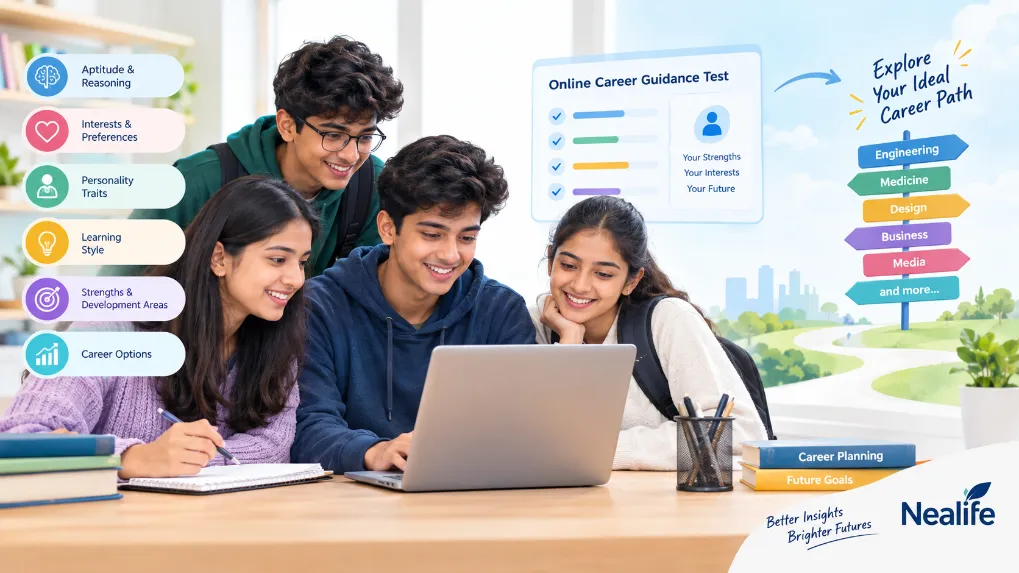
A structured assessment can consider multiple dimensions, including:
This creates a more complete picture of the student rather than relying on a single examination score.
🚀How an Online Career Guidance Test India Can Help Students
An Online Career Guidance Test India can give students a structured starting point for career exploration. Instead of depending entirely on informal advice, students can receive assessment-based insights that help them understand their preferences and abilities.
The process generally begins with an assessment designed to evaluate relevant psychological or career-related dimensions. The results can then be interpreted to identify areas that may align with the student’s profile.
💪1. Identify Personal Strengths
✨Students often know what subjects they like but may not clearly understand their strongest abilities. An assessment can help highlight areas such as verbal reasoning, numerical ability, logical thinking, problem-solving, or interpersonal skills.
Knowing these strengths can make career exploration more focused.
❤️2. Understand Interests
✨Interest plays an important role in long-term engagement. A student may be capable of performing well in a particular subject without actually enjoying work related to it.
Career assessment can help identify patterns in what the student naturally prefers, helping them explore career options that are more personally relevant.
🧭3. Explore Suitable Career Directions
✨The purpose of an assessment should not be to place a student into one fixed profession. Instead, it should open relevant career possibilities.
For instance, a profile showing strong analytical ability and an interest in technology could encourage exploration of fields such as data analytics, software, engineering, cybersecurity, or technology-related roles.
The final decision should still consider education requirements, personal circumstances, career opportunities, and the student’s own goals.
🗺️From Assessment to Career Planning
Taking an assessment is only the beginning. The real value comes from using the findings to create an actionable career plan.
Students can follow a simple process:
This approach can help students move from uncertainty to a more structured decision-making process.
Parents can also participate in the process. Instead of suggesting a career based solely on personal expectations, they can use assessment insights as a starting point for an open conversation with their child.
🧪What Is Pre-Employment Psychometric Testing and Why Is It Relevant?
Pre-Employment Psychometric Testing is commonly associated with recruitment and employee selection. These assessments are designed to evaluate characteristics such as cognitive ability, personality, behavioural tendencies, and other job-related attributes.
Although career assessment and recruitment assessment serve different purposes, the underlying principle is similar: structured assessment can provide information about an individual’s characteristics that may not be obvious from academic scores or a résumé alone.
For students, understanding aptitude, personality, interests, and behavioural tendencies can support better self-awareness before entering higher education or the workplace.
For organisations, psychometric assessment can contribute to more structured hiring and talent evaluation when appropriately designed and interpreted.
⚖️Career Assessment vs. Choosing a Career by Marks Alone
Marks can indicate academic performance, but they should not be treated as the only factor in career selection.
| 📌 Factor | 💡 What it can tell students |
|---|---|
| 📝 Academic performance | Subject knowledge and academic progress |
| 🧠 Aptitude | Certain cognitive abilities and problem-solving strengths |
| ❤️ Interests | Areas the student naturally enjoys |
| 🌈 Personality | Behavioural preferences and tendencies |
| 🛠️ Skills | Existing capabilities and areas for development |
| 🔎 Career research | Education requirements and professional opportunities |
Combining these perspectives can give students a more balanced basis for decision-making.
👨👩👧How Parents Can Support Better Career Decisions
Parents have an important role, but career discussions should be collaborative rather than pressure-driven.
Instead of asking, “Why don’t you become an engineer?”, parents can ask:
An Online Career Guidance Test India can provide an additional evidence-based discussion point between students, parents, and career professionals.
🌿How Nealife Can Support Career and Psychometric Assessment
Nealife focuses on assessment-based solutions that can help individuals and organisations understand abilities, behavioural characteristics, and psychological dimensions more systematically.
For students, career assessment can be useful when they are uncertain about their strengths, interests, academic direction, or future career possibilities. For employers, Pre-Employment Psychometric Testing can support structured assessment during recruitment and talent-related processes.
The important point is that assessment results should be interpreted as guidance—not as an automatic decision about someone’s future. Students should combine assessment insights with professional guidance, education research, practical exposure, and their own aspirations.
❓Frequently Asked Questions
1. How can I know which career is right for me?
Understanding your interests, aptitude, personality, strengths, values, and goals can help you identify suitable career directions. A structured career assessment can provide useful insights before you compare courses and career options.
2. Is there a test to help me choose the right career?
Yes. An Online Career Guidance Test India can assess areas such as interests, aptitude, personality, and strengths to help students explore career options that may suit their individual profile.
3. Can a career test help me if I am confused after Class 10 or Class 12?
Yes. Career assessment can be particularly useful when students are deciding between academic streams after Class 10 or considering degree courses and professional options after Class 12.
4. Does a career guidance test consider my interests and personality?
Many career assessments consider multiple factors, which may include interests, personality characteristics, aptitude, strengths, preferences, and motivations. Looking at these areas together can provide a broader understanding of suitable career directions.
5. Can an Online Career Guidance Test India predict my exact future career?
No. An assessment should not be treated as a guaranteed prediction. It provides structured insights and possible career directions that should be combined with research, guidance, education planning, and practical experience.
6. What is Pre-Employment Psychometric Testing used for?
Pre-Employment Psychometric Testing is commonly used during recruitment to evaluate job-related characteristics such as cognitive abilities, personality traits, behavioural tendencies, and other relevant attributes.
7. Is psychometric testing useful for students?
Psychometric assessments can provide useful information about abilities, personality, interests, and behavioural tendencies. For students, these insights may support self-awareness and informed career exploration when used appropriately.
8. What should I do after taking a career assessment?
Review the results carefully, identify career areas that interest you, research relevant courses and qualifications, understand the skills required, and consider practical exposure. Discussing the results with a qualified career professional can also be helpful.
🏁Conclusion
The right career decision does not come from marks, trends, or other people’s expectations alone. It begins with understanding who the student is—their strengths, interests, abilities, personality, and aspirations.
An Online Career Guidance Test India can provide structured insights that make career exploration more focused, while assessment methodologies such as Pre-Employment Psychometric Testing demonstrate how structured evaluation can support better understanding of individual characteristics in professional settings.
Students and parents can use these insights as one part of a broader decision-making process that includes research, expert guidance, skill development, and real-world exposure.
Want to understand your strengths and explore suitable career directions? Explore Nealife’s assessment solutions and take the next step toward more informed career planning.