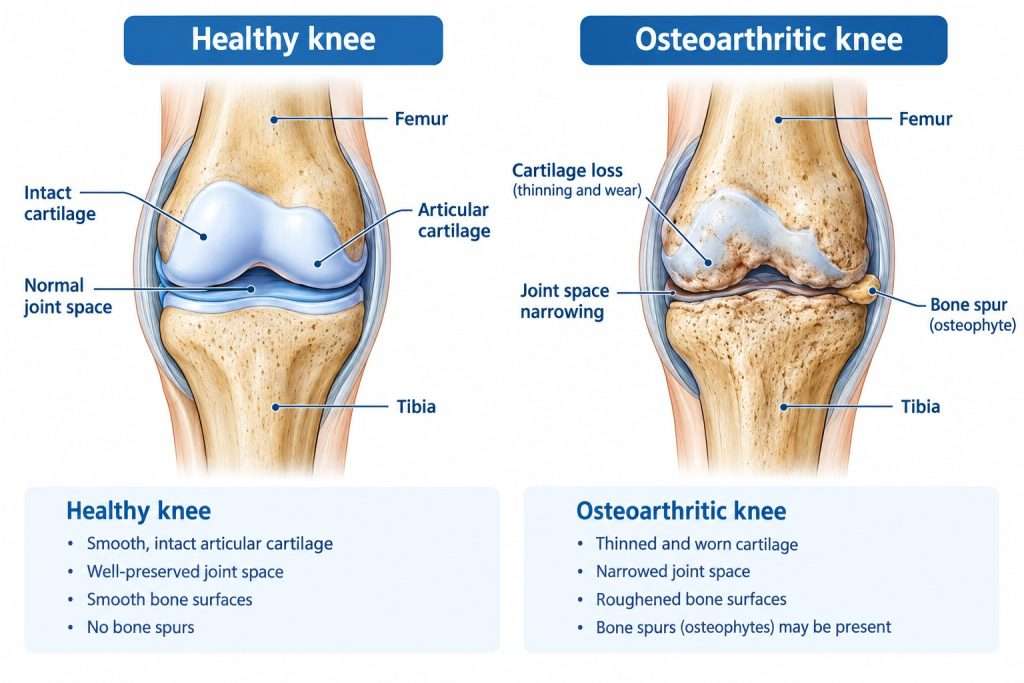
Knee pain can begin as a minor inconvenience and gradually start affecting your everyday life. Walking, climbing stairs, getting up from a chair, exercising, or even sleeping may become difficult when knee pain and stiffness persist.
But when do you need knee replacement?
Not everyone with knee arthritis needs surgery. Treatment often begins with non-surgical options such as exercise, physiotherapy, weight management, medications, activity modification, or other appropriate treatments. However, when persistent knee pain, stiffness, reduced mobility, or deformity continues to affect your quality of life despite appropriate treatment, knee replacement may become an option.
If you are experiencing ongoing knee pain, consulting an Orthopedic Doctor in Punawale can help determine the underlying cause and identify the most appropriate treatment for your condition. An orthopedic specialist can assess your symptoms, physical function, medical history, and imaging findings before discussing whether conservative treatment or joint replacement is appropriate.
If knee pain is affecting your everyday life and you are searching for a Knee Replacement Surgeon in Punawale, understanding the warning signs can help you know when an orthopedic evaluation is appropriate.
What Is Knee Replacement?
Knee replacement, also called knee arthroplasty, is a surgical procedure in which damaged surfaces of the knee joint are replaced with artificial components.
It is commonly considered for people with significant knee joint damage caused by conditions such as osteoarthritis.
The main goals of knee replacement are to:
- Reduce persistent knee pain
- Improve walking ability
- Improve knee function
- Reduce disability caused by advanced joint disease
- Help patients return to appropriate daily activities
- Improve quality of life
Knee replacement is not simply a treatment for an abnormal X-ray. The decision depends on how the condition affects the patient, the severity of symptoms, examination findings, previous treatments and individual expectations.
When Do You Need Knee Replacement?
There is no single age, pain score or X-ray finding that automatically means you need knee replacement.
Instead, several warning signs can indicate that it is time to discuss surgical options with an orthopedic specialist.
1. Persistent Knee Pain Is Affecting Your Daily Life
One of the most important warning signs is persistent pain that interferes with normal activities.
You may notice difficulty with:
- Walking
- Climbing stairs
- Standing for long periods
- Shopping
- Household activities
- Getting into or out of a chair
- Travelling
- Exercising
- Sleeping comfortably
If knee pain is repeatedly forcing you to change what you do every day, an orthopedic evaluation is worthwhile.
2. Pain Continues Despite Non-Surgical Treatment
Knee replacement is generally not the first treatment for osteoarthritis.
Depending on the patient, treatment may include:
- Therapeutic exercise
- Physiotherapy
- Weight management when appropriate
- Pain-relieving medication
- Activity modification
- Selected injections
- Other conservative measures
AAOS guidance includes exercise and other non-surgical approaches among treatments used to manage symptomatic knee osteoarthritis.
If appropriate treatments have been tried and symptoms remain severe, surgery may need to be discussed.
3. Walking Has Become Increasingly Difficult
If you once walked comfortably but now need frequent breaks because of knee pain, stiffness or weakness, do not simply assume it is part of getting older.
Reduced walking ability can be a sign that knee disease is significantly affecting function.
An orthopedic assessment can help determine whether the problem is coming primarily from arthritis or whether another condition may be contributing to your symptoms.
4. Stairs Have Become a Major Problem
Difficulty going up or down stairs is a common complaint among people with significant knee problems.
You may notice that you:
- Hold the railing constantly
- Take one step at a time
- Avoid stairs whenever possible
- Experience severe pain while bending the knee
- Feel unstable while going downstairs
If stairs are becoming a major barrier to everyday life, it is worth discussing your symptoms with an orthopedic specialist.
5. Knee Stiffness Is Limiting Movement
Pain is not the only problem associated with advanced knee disease.
Stiffness can make it difficult to:
- Fully bend the knee
- Straighten the leg
- Sit comfortably
- Stand up
- Get into a car
- Perform daily activities
Reduced range of motion combined with significant pain and joint damage may indicate that conservative treatment is no longer providing enough benefit.
6. Knee Pain Is Disturbing Your Sleep
Night pain deserves attention.
If your knee hurts while resting or repeatedly wakes you during the night, it can affect:
- Sleep quality
- Energy
- Mood
- Work performance
- Physical activity
- Overall quality of life
Night pain alone does not automatically mean you need knee replacement. However, persistent pain at rest is a reason to seek a proper evaluation rather than simply continuing to tolerate it.
7. You Are Depending More and More on Pain Medication
If you increasingly rely on pain medication simply to get through normal activities, speak with an orthopedic specialist.
Medication can play a role in symptom management, but long-term medication use may not address the underlying structural problem.
The suitability of any medicine depends on your medical history and other health conditions, so medication decisions should be made with a qualified healthcare professional.
8. Your Knee Is Becoming Misaligned or Deformed
Advanced arthritis can sometimes be associated with changes in knee alignment.
You may notice that your legs or knees appear increasingly bowed or that the alignment of the knee has changed.
Progressive deformity combined with pain and reduced function can be one reason an orthopedic specialist considers whether joint replacement may be appropriate. NICE specifically includes progressive joint deformity among symptoms that can substantially affect quality of life when considering referral for joint replacement.
9. Knee Pain Is Limiting Your Quality of Life
This is one of the most important factors.
Ask yourself:
What can I no longer do because of my knee?
Perhaps you have stopped:
- Going for walks
- Playing with your children or grandchildren
- Travelling
- Going shopping
- Participating in hobbies
- Exercising
- Attending social activities
If knee problems are shrinking your daily life, it may be time for a more detailed orthopedic assessment.
The decision about joint replacement should consider the impact of symptoms on quality of life rather than relying on an arbitrary numerical threshold.
Does Severe Knee Arthritis Always Mean You Need Surgery?
No.
This is an important distinction.
An X-ray may show significant osteoarthritis, but surgery is not automatically required.
Likewise, someone may have significant symptoms that deserve treatment even if imaging findings do not tell the entire story.
NICE recommends using clinical assessment when deciding whether someone should be referred for joint replacement rather than relying on numerical severity scores alone.
Your doctor will typically consider:
- Your symptoms
- Physical examination
- Mobility
- Joint function
- Imaging when clinically appropriate
- Previous treatment
- Overall health
- Expectations and lifestyle goals
What Are the Alternatives to Knee Replacement?
Before considering surgery, an orthopedic specialist may discuss non-surgical treatment depending on your condition.
Physiotherapy and Exercise
Exercise is an important part of knee osteoarthritis management.
A suitable program may help improve:
- Muscle strength
- Joint mobility
- Balance
- Physical function
- Confidence with movement
AAOS recommends supervised, unsupervised and aquatic exercise over no exercise for improving pain and function in knee osteoarthritis.
However, exercise cannot reverse severe structural joint damage. Its purpose is to improve function and manage symptoms.
Weight Management
For patients who are overweight or living with obesity, weight management may be part of an overall treatment plan.
It can reduce stress on weight-bearing joints and may improve mobility and general health.
NICE identifies therapeutic exercise and weight management where appropriate among core non-surgical approaches for osteoarthritis.
Medication
Depending on your medical history, your doctor may recommend medication to manage pain.
Possible options can include:
- Topical medicines
- Anti-inflammatory medicines
- Other appropriate pain-relieving medicines
Not every medication is safe for every patient. Existing kidney, stomach, heart and other health conditions can affect which medicines are appropriate.
Injections
Some patients may receive injections to help manage knee symptoms.
The expected benefit varies depending on the treatment and the individual patient.
An injection should not automatically be considered a permanent solution for advanced arthritis.
Braces and Supportive Devices
A brace or supportive device may be useful for selected patients depending on the location of arthritis, alignment, stability and functional needs.
These treatments do not work equally well for everyone.
Partial Knee Replacement vs Total Knee Replacement
If surgery is required, it does not necessarily mean that the entire knee must be replaced.
Partial Knee Replacement
A partial knee replacement replaces the damaged portion of the knee while preserving suitable healthy areas.
It may be considered in carefully selected patients whose arthritis is limited to a particular compartment.
Total Knee Replacement
Total knee replacement replaces damaged joint surfaces more extensively.
It may be considered when arthritis affects multiple areas of the knee and symptoms are sufficiently severe.
The choice between partial and total replacement depends on the individual patient’s knee condition.
NICE guidance states that people with isolated medial compartment osteoarthritis may be offered a choice between partial and total knee replacement, with the benefits and risks of each discussed with the patient.
How Does an Orthopedic Surgeon Determine Whether You Need Knee Replacement?
A proper evaluation is more than looking at an X-ray.
Step 1: Discuss Your Symptoms
Your doctor may ask:
- How long have you had knee pain?
- Where exactly does it hurt?
- Does it hurt during activity or at rest?
- Does it disturb your sleep?
- How far can you walk?
- Can you climb stairs?
- Do you feel unstable?
- Which activities have you stopped doing?
Step 2: Examine Your Knee
The examination may assess:
- Range of motion
- Stability
- Alignment
- Swelling
- Tenderness
- Muscle strength
- Walking pattern
Step 3: Review Imaging
X-rays and other investigations may be used when clinically appropriate to understand the structural condition of the knee.
But an image should be interpreted alongside your symptoms and physical examination.
Step 4: Review Previous Treatments
Your orthopedic surgeon may ask what you have already tried.
This could include:
- Physiotherapy
- Exercise
- Medication
- Weight management
- Injections
- Bracing
- Activity modification
Step 5: Discuss Your Expectations
A treatment decision should also consider what you want to achieve.
For example:
“I want to walk 30 minutes without severe pain.”
or
“I want to climb stairs independently.”
These goals help create a realistic treatment discussion.
5 Signs You Should Schedule an Orthopedic Consultation
If you are experiencing several of the following symptoms, consider getting evaluated:
- Persistent knee pain
- Difficulty walking or climbing stairs
- Pain that affects sleep
- Significant stiffness or reduced movement
- Symptoms continuing despite appropriate non-surgical treatment
These signs do not prove that you need surgery.
They indicate that your knee deserves professional assessment.
Common Mistakes Patients Make
Waiting Until They Cannot Walk
You do not need to wait until your knee becomes almost unusable before seeing an orthopedic specialist.
An earlier consultation can clarify your options without automatically committing you to surgery.
Assuming Age Determines Surgery
There is no single age at which everyone should receive knee replacement.
NICE specifically advises against excluding people from consideration for joint replacement based solely on age.
Believing an X-Ray Alone Determines the Need for Surgery
An X-ray is useful, but it is only one part of the assessment.
Your symptoms and functional limitations matter.
Assuming Every Knee Pain Needs Replacement
Knee pain can have many causes.
Arthritis, ligament problems, meniscal conditions, inflammation and other issues can produce knee symptoms.
A proper diagnosis comes before choosing treatment.
How to Prepare for Your Orthopedic Consultation
Before visiting an orthopedic specialist, write down:
- When your pain started
- What activities make it worse
- Whether pain occurs at night
- How far you can walk
- Previous treatments
- Current medications
- Previous injections
- Other relevant medical conditions
- Your main treatment goals
This information can make the consultation more productive.
Choosing a Knee Replacement Surgeon in Punawale
If you are searching online for the Best Orthopedic Surgeon in Punawale, do not make your decision based only on rankings, advertisements or the number of procedures listed on a website.
Instead, look for a specialist who:
- Performs a detailed clinical assessment
- Explains the diagnosis clearly
- Discusses non-surgical options
- Explains when surgery may be appropriate
- Discusses realistic benefits and risks
- Answers your questions
- Provides a clear recovery and rehabilitation plan
The right question is not simply:
“Who is the best surgeon?”
A better question is:
“Which orthopedic specialist can properly evaluate my condition and help me make an informed treatment decision?”
Why Early Orthopedic Evaluation Can Be Valuable
Seeing an orthopedic specialist does not mean you have agreed to surgery.
That misconception causes many patients to delay consultation.
An evaluation can simply tell you:
- What may be causing your pain
- How severe the condition appears to be
- Which treatments remain available
- Whether surgery is appropriate
- What you can do to manage symptoms
NICE recommends considering joint replacement when symptoms substantially affect quality of life and appropriate non-surgical management has been ineffective or unsuitable.
That means the decision is not simply “pain = surgery.”
It is a broader clinical decision.
Key Takeaways
- Persistent knee pain does not automatically mean you need knee replacement.
- Surgery may be considered when pain, stiffness or reduced function significantly affects quality of life.
- Non-surgical treatments such as exercise, physiotherapy and weight management can be important parts of treatment.
- An X-ray alone should not determine whether you need surgery.
- Partial and total knee replacements are different procedures.
- Age alone should not determine whether someone is considered for joint replacement.
- If pain is affecting walking, sleep, stairs or everyday activities, an orthopedic assessment is reasonable.
- A qualified Knee Replacement Surgeon in Punawale can help you understand whether surgery or another treatment is appropriate for your condition.
Frequently Asked Questions
1. When do you need knee replacement?
Knee replacement may be considered when persistent knee pain, stiffness or reduced function substantially affects quality of life and appropriate non-surgical treatments have not provided enough relief. The decision should be based on an individual clinical assessment.
2. Can knee arthritis be treated without knee replacement?
Yes. Depending on the severity and individual circumstances, treatment may include therapeutic exercise, physiotherapy, weight management, medication, injections or other conservative approaches.
3. Does severe arthritis on an X-ray mean I need knee replacement?
Not necessarily. X-ray findings should be considered together with symptoms, physical examination, functional limitations and previous treatment. Clinical assessment is important when deciding whether joint replacement should be considered.
4. What is the difference between partial and total knee replacement?
A partial knee replacement replaces the damaged compartment of the knee when the remaining joint is suitable. A total knee replacement replaces damaged joint surfaces more extensively. The appropriate procedure depends on the pattern and severity of joint damage.
5. How do I find a Knee Replacement Surgeon in Punawale?
Look for an orthopedic specialist who evaluates your individual symptoms, explains both surgical and non-surgical options, discusses realistic outcomes and risks, and provides an appropriate treatment and rehabilitation plan.